
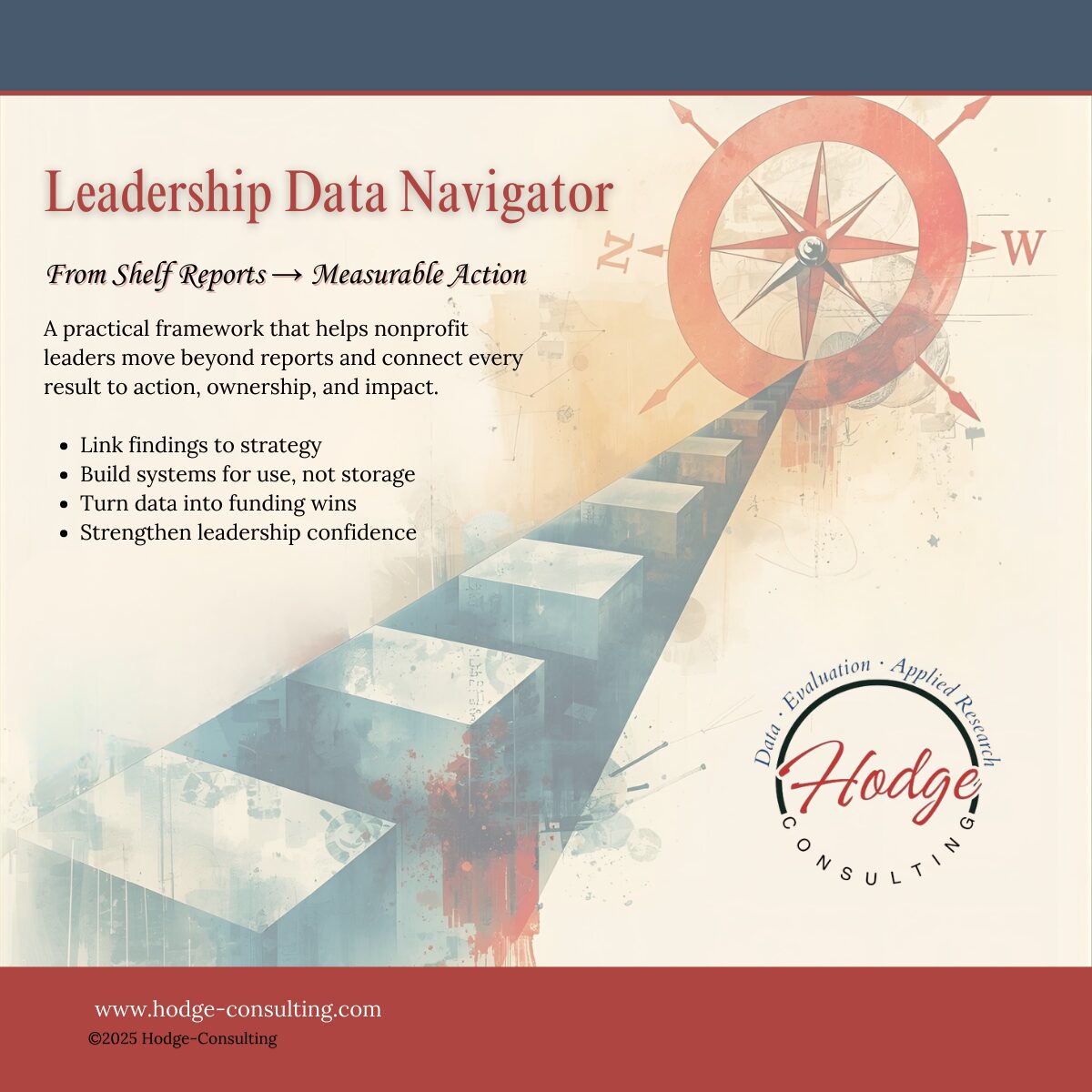
From Shelf to Strategy: Building Leadership Capacity with the Data Navigator
If you’ve ever worked in a nonprofit or school setting, you’ve probably seen it: a data report is delivered, shared at a board meeting, maybe emailed to staff… and then shelved. This isn’t about effort. It’s about capacity. Leaders need data AND the tools and confidence to use those data. Without that, data is documentation. With it, data becomes direction. This is why Hodge-Consulting developed the Leadership Data Navigator. It helps leaders stop drowning in numbers and start connecting every finding to an action, an owner, and a metric.
As I shared in my recent presentation Less Yawn, More Action, reports often fail to move organizations forward because:
- No clear ownership. Everyone owns it, so no one owns it.
- Too broad. Findings are interesting but not actionable.
- Misaligned priorities. Reports don’t connect to the strategic plan, so they get sidelined
The difference between a report that collects dust and one that changes your organization is the intentional step of connecting each finding to an action.
The Navigator is a framework that helps leaders transform static results into actionable strategy. It rests on three pillars:
- Clarity – Ask the Right Questions
Instead of “What does the data say?” leaders learn to ask “What does this mean, and what will we do with it?” - Capacity – Build the Right Systems
Dashboards, regular data reviews, and staff training turn data into something leaders use, not fear. Sometimes a Small investment will yield big clarity. Simple tools like Excel or Google Sheets can build early warning systems and improve decision-making - Connection – Link Data to Action
Every data point should connect to a decision: program revisions, funding allocations, curriculum refinements, or leadership priorities. Without that step, reports remain shelf décor.
Here’s an example: From Result to Leadership Question
- Finding: 54% of youth completed their recommended program plan (goal was 75%).
- Implication: Not meeting the goal could raise concerns about program engagement, funding, staffing distribution, content applicability. etc.
- Leadership Question: What changes in delivery or support could improve this outcome? Are there existing models we could adapt? How can we dive in to use this finding to improve outcomes for our clients.
This shift, from results to leadership action, is where the Leadership Data Navigator builds capacity. When leaders use the Navigator, they normalize asking: “What does this mean, and what’s next?” That’s how data moves from shelf reports to strategic decisions.
Benefits include:
- Better communication with boards, funders, and partners
- Program improvements rooted in evidence
- Early warning systems for risks or inequities
- Greater staff engagement with results
Numbers don’t change outcomes, leaders do. The Leadership Data Navigator equips nonprofit and school leaders to build capacity, take ownership, and connect every result to strategy. Because at the end of the day, a report isn’t successful when it’s delivered. It’s successful when it drives change.
If your organization is ready to build data capacity that goes beyond shelf reports, let’s connect.